Is Solo Diving as Dangerous as They Say It Is?
As long as people dive, solo diving has been a recurring topic. Many like to state, “Never dive alone,” and that is cute, but not very realistic.
The majority of divers occasionally dive alone. And as you continue diving, there will be times that your buddy does not look at you. Occasional separation happens; cultivate your independence, appreciate the buddy system when it works, but be comfortable in your own skin when it doesn’t.
Don’t let anyone convince you that solo diving is dangerous; there is no hard data on accident rates that suggests that. When you’re diving in a group your subject to a whole range of distractions and stupidities that solo divers are not affected by. Having a solo diver’s mindset could actually be life-saving.
Safety Diver and Solo Diving: FCOA Definitions
A safety diver who has appropriately responded to at least 3 of your unannounced simulated blackouts in the last year. Trust has to be earned; you have to form a bond between you and your safety diver. We do so by faking unannounced blackouts. To consider someone as your competent safety diver, you must personally experience that they respond appropriately. The fact that a diver says to be experienced or certified does not automatically mean they are competent: We don’t know the quality of their training and their recency.
A solo diver who dives by himself or who dives without specifically agreeing with a competent safety diver to be looked after during the entirety of a particular breath-hold dive.
What the 83% Stat Really Tells Us
When you dive alone, you know very well no one will come help you when things go wrong. Therefore, quite naturally, you dive more conservatively, less deep, less long, and you pay more attention.
The Divers Alert Network on freediving casualties points out how hard it is to collect data since not everything gets reported. But their data from 2015 shows that from all freedivers who died that year, 83% had company and 17% had no company.
There is no available data on the total number of hours that freedivers dived with company and without company for 2015. And without that data, we can not conclude which form of diving is safer.
But what we can see is that 83% of the freedivers who died had company.
And then you think by yourself, how can it be that all those divers died with a buddy by their side?
The False Security of the Pack
Divers often feel overconfident in groups; they feel this “false sense of security” that nothing can go wrong as long as they are together. At the same time, due to group pressure, divers want to prove themselves; they like to show off a little and dive a bit deeper and a bit longer; therefore, they are more likely to push past their limits and pass out when they are with company.
Also, groups are often very unorganized, and often there is no clear leader. So then the whole group is just all over the place, maybe drifting to open sea, maybe not. There might be a buddy system; there might not. The group feels safe because they are together, yet they are now further from shore than ever. And all at once one person panics, and panic is contagious; it spreads like wildfire, and it sucks the energy out of a group in a matter of seconds.
Don’t be a hypocrite; don’t tell your students “Never dive alone” while often enough you do it yourself. It’s not healthy. It creates a taboo.
Solo diving is as old as humankind. All divers do it, yet most won’t admit it to avoid confrontation. “Solo diving” is a topic that deserves a paragraph in every dive manual. It should not say “Never dive alone” because divers do that anyway. It should say: “If you choose to dive alone, let us explain how to do it at minimum risk”.
In this way, solo divers don’t get excluded, and they are more likely to ask for advice. Also, with the topic open for discussion, experienced solo divers will feel valued and will be more likely to share their knowledge and experiences.
Don’t take anything you get told for granted, do your own research, value the facts more than the theories, and draw your own conclusions.
The True Risks of Solo Diving
Hypoxic Blackout: The risk of hyperventilation

When you hold your breath, two things happen in the body at the same time. Your oxygen goes down. Your carbon dioxide goes up. Many people think that you feel you have to breathe because your oxygen is low. But that is not true. The feeling of burning in your chest and the movements of your diaphragm mostly start when your CO2 levels go up, not when your oxygen is low.
When a freediver passes out in the water, this is usually because of a lack of oxygen, called a Hypoxic Blackout. When it happens in shallow water, people often call it a Shallow Water Blackout.
Normal Sequence:
Oxygen drops. You feel a need to breathe because of CO2. You go to the top and take a breath.
Hypoxic Blackout Sequence:
Oxygen drops below a safe level. After that, you lose consciousness. There is no warning before this happens.
The Silent Mechanism

A blackout happens when there is not enough oxygen in the blood. The brain needs a certain amount of oxygen to stay awake. If it gets less than what is needed, you black out. Here are some key points:
- There are often no warning signs. Blackouts happen right away and do not hurt. A diver does not fight or struggle when this happens. They just lose consciousness.
- Hyperventilation disguises oxygen levels. If a diver breathes fast before a set, they get rid of CO2 but do not get more oxygen. This makes them feel like they do not need to breathe yet. Because of this, O2 can drop too low before CO2 gets high enough to warn them of risk.
Laryngospasm and Water Ingestion
When a diver goes unconscious underwater, the body has a reflex called a laryngospasm. This closes the vocal cords for a short time to stop water from getting into the lungs.
However, this reflex does not last long. When the lack of air gets worse, the throat muscles let go. If there is no one to help pull the diver’s face out of the water right away, the person will start to gasp under the water without meaning to. Water gets into the lungs. This starts the process of drowning and causes the heart to stop beating fast.
The Myth of “Self-Rescue” in Water
Many people say things like, “I’m only doing 50% of my max,” or “I’m in three feet of water—if something happens, I’ll just stand up,” when they practice alone in the pool.
This shows a basic misunderstanding of how the brain is affected by low oxygen.
Hypoxia Escalation Path:

Loss of Motor Control (LMC / “Samba”)
Before a full blackout happens, or in place of that, very low oxygen often makes people lose motor skills. People in the freediving group often call this a samba.
During an LMC, the brain does not have power over basic muscle moves. A diver can start to shake hard, drop their body shape, not be able to hold onto the side of the pool, or not be able to lift their chin above the water. In this state:
- You cannot get up.
- You cannot turn over.
- You cannot clear your own throat.
A diver who has an LMC in just six inches of water can drown very easily. This can happen if there is no one with them to keep their face above the water.
Why Depth Does Not Matter

Most freediving accidents don’t happen at 40 meters in deep water. They usually happen at the surface or in swimming pools while people practice holding their breath still or while they move across the pool. Deeper water helps with pressure as you go up, but in a pool, there is nothing like that. It’s just about how much oxygen you run out of. When you are not deep at all, you have no protection against passing out.
The Role of a Competent Safety Buddy
Having a friend close by in a pool or just looking over while busy with a phone is not safe enough. A competent safety buddy stays alert and is there to help save your life.
SAFETY BUDDY DUTIES
- Active Visual Tracking (Touch / Eye)
- Surface Support (Airway Management)
- Keeping the mouth out of the water in case of a blackout
A trained safety buddy provides:
- Constant 1-on-1 Watching: They keep an eye on the diver at all times during the entire hold or lap. They stay close to the diver at the end and never look away.
- Keeping Airway Clear at the Top: When the diver comes up, the buddy makes sure the airway does not go underwater. The buddy watches the diver for 30 to 45 seconds after surfacing. This is the most important time because blackouts or LMCs can occur now when there is not enough oxygen in the blood going to the brain.
- The most important thing to do blackout happens is to keep the mouth out of the water. If this isn’t done correctly, the diver could die. Any additional action is secondary and optional, whether it’s blow, tap, talk, or removal of equipment.
If a diver faints underwater and you help them right away, they wake up safe. They will not breathe in water or have problems later. But if they do not have a competent safety diver with them, the same thing can cause death.
Safe Alternatives: How to Train Solo

Freedivers can build a lot of skill or strength on land by doing dry apnea exercises.
| Training Type | Environment | Primary Focus / Benefit |
| Dry Static Tables CO2 & O2) | Bed, couch, or soft floor | Safely increases CO2 tolerance and mental relaxation under hypoxia. |
| Walking Apnea | Carpeted hallway or grass track | Simulates dynamic exertion and mental toughness under lactic acidosis. |
| Diaphragmatic Stretching | Dry land / Yoga mat | Improves lung flexibility, chest wall compliance, and residual volume capacity. |
| Equalization Drills | Desk or dry land | Isolates the soft palate, tongue, and glottis (Frenzel/Mouthfill) using air-shape tools. |
In dry training, if you feel a blackout or feel a very strong need to breathe, you just start to breathe right away. Or you can fall back on a soft bed. There is no water, so you do not have to worry about drowning.
The Bottom Line on Going Solo
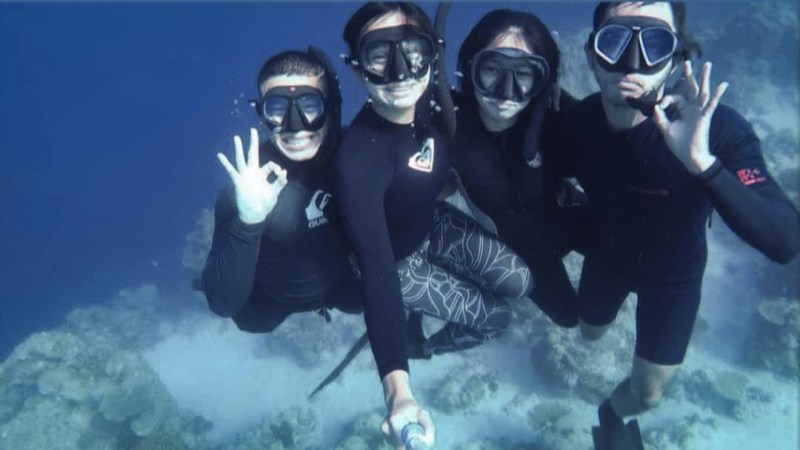
Let’s be real—the whole solo diving debate highlights a massive disconnect between dive rules and reality. Yelling “Never dive alone!” when most of us end up training by ourselves eventually does more harm than good. It shuts down real conversations about safety and tricks people into thinking any group dive is automatically safe.
Real safety comes from self-reliance and understanding the facts, not just following dogma. Whether working with coaches or diving with a partner, don’t settle for a safety diver in name only. You need someone reliable, who you’ve personally tested, and who actually has their eyes on you. And when you’re training solo, play it smart: save the wet breath-hold sets for dry land and stay ultra-conservative in the water.